China 50kw Ev Charger Manufacturer & Factory

Next-Generation DC Fast Charging Stations & B2B Solutions for Commercial Infrastructure

50kW DC EV Chargers: The Sweet Spot of Global Charging Infrastructure

An analytical breakdown of technology trends, application scenarios, and purchasing dynamics.

The Strategic Value of the 50kW Power Rating

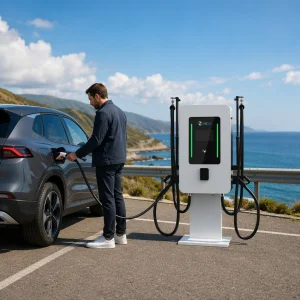
As the transition towards electric mobility accelerates worldwide, infrastructure planners are faced with balancing energy supply, grid installation costs, and passenger wait times. While ultra-fast megawatt-scale chargers (such as 360kW or 480kW split systems) generate headline news, the 50kW DC EV Charger remains the foundational workhorse for commercial, fleet, and public infrastructure deployments globally. It delivers the perfect compromise between installation cost, thermal footprint, and grid compatibility.

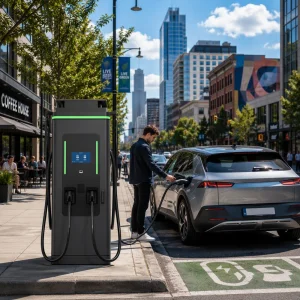
Operating a 50kW charger does not require the capital-intensive medium-voltage substation upgrades typically associated with high-power 150kW+ units. A standard 400V AC grid connection is generally sufficient. It provides fleet operators and local merchants with an efficient Level 3 charging capacity, charging a mid-sized passenger electric vehicle from 20% to 80% state of charge (SoC) in approximately 45 to 60 minutes—coinciding perfectly with typical retail dwell times and driver break intervals.

Global Procurement Trends and Technical Requirements

For international buyers, including CPOs (Charge Point Operators), commercial property managers, and governmental agencies, securing equipment from a trusted China 50kW EV Charger manufacturer requires a deep understanding of standard compliances, modular redundancy, and software integration capabilities:

  • Multi-Protocol Flexibility: Global interoperability demands that stations support various plug standards, including CCS1 (for North America), CCS2 (for Europe and international markets), CHAdeMO (primarily for Japanese vehicles), and the Chinese national GBT standard. As Tesla opens its design, manufacturers are increasingly integrating NACS (North American Charging Standard) connectors directly into their product offerings.
  • OCPP and Network Interoperability: A modern DC charging station must run Open Charge Point Protocol (OCPP 1.6J or OCPP 2.0.1) to allow seamless backend integration with billing platforms, remote management hubs, and dynamic load balancing software.
  • TCO (Total Cost of Ownership) Optimization: Smart buyers prioritize modular internals. A 50kW charger configured with multiple, hot-swappable 20kW or 30kW power modules is far more resilient than one relying on a single large power block. If one module experiences a fault, the charger continues to operate at a reduced capacity rather than shutting down completely.

MIDA Power Group by the Numbers

15+
Years of R&D Experience
80+
Exporting Countries
1000A
Max Liquid-Cooled Capacity
IP55+
All-weather Protection Level

WELCOME TO MIDA GROUP

Empowering Global Electrification through Advanced Cable and Charging Engineering.

Shanghai Mida Cable Group Ltd. operates through its wholly owned subsidiaries: Shanghai Mida EV Power Co., Ltd., Shenzhen Mida EV Power Co., Ltd., and Shanghai Mida New Energy Co., Ltd. This integrated operational structure allows Mida to cover the entire EV component value chain from raw cable production to high-level power module programming.

Mida Cable manufactures a comprehensive range of EV charging cables, including 16A–80A J1772 cables, 16A–63A IEC 62196-2 Type 2 cables, and heavy-duty DC fast charging cables: CCS1 (80A–500A), CCS2 (125A–1000A), CHAdeMO (125A–300A), GBT (200A–1000A), and NACS connectors (250A–600A).

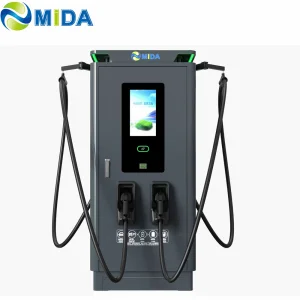
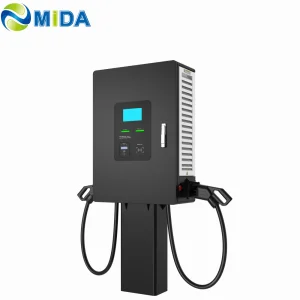
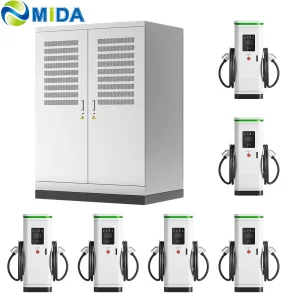
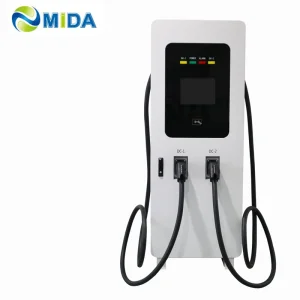
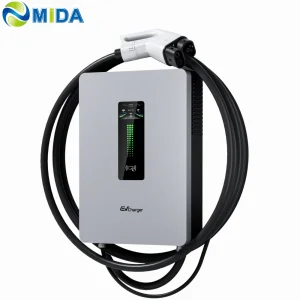
MIDA EV Power produces a full lineup of EV charging stations, such as 7kW–50kW mobile chargers, 3.6kW–7.2kW portable DC chargers, 360kW–1440kW split-type DC fast chargers, 20kW–50kW wall-mounted DC chargers, and 60kW–480kW floor-standing DC fast charging stations.

MIDA New Energy specializes in EV charger power modules, offering 20kW–60kW standard modules, 40kW–125kW liquid-cooled modules, 30kW–62.5kW bidirectional modules, and 20kW–45kW V2G charging modules.

Mida Group Certification and Factory View

China Factory 4.0: Achieving Supply Chain Resilience & Cost Advantages

The Competitive Landscape of China-Based Production

China's dominance in the EV charging market is not merely a matter of lower labor costs. Rather, it is the result of a highly concentrated, localized industrial ecosystem. In automotive and power electronics hubs such as Shenzhen, Shanghai, and Suzhou, a 50kW EV charger manufacturer has immediate proximity to critical component suppliers: semiconductor makers, magnetic core winders, sheet metal fabrication shops, and premium copper cable extruders. This high-density supply chain significantly reduces transit times and transport overhead, establishing unmatched responsiveness in procurement.

Advanced Automation and Quality Control in Manufacturing

Deploying Industry 4.0 methodologies is paramount to achieving the strict reliability indexes required by global certification bodies. Standard operations at our factories utilize automated optical inspection (AOI), robotic component placement, and dynamic environmental burn-in testing chambers. Every single 50kW power unit undergoes continuous full-load stress testing at elevated temperatures to guarantee peak performance. Advanced silicon carbide (SiC) semiconductor packaging reduces switching losses and increases overall electrical conversion efficiency to over 96%, minimizing operational waste heat.

MAIN PRODUCT SEGMENTS

Explore our diverse architecture designed to power the next generation of transportation.

EV Charging Power Module

  • 30kW 40kW 50kW 60kW 80kW AC/DC Modules
  • 30kW 40kW 50kW 60kW DC/DC Converter Modules
  • 40kW 60kW 75kW 125kW Liquid-Cooled Power Modules
  • 20kW 22kW 30kW 40kW 45kW Bidirectional V2G Modules
  • 30kW 40kW 50kW 60kW Solar MPPT Modules
View More Modules

DC Connectors & Cooling

  • 500A 600A CCS1 & CCS2 & GBT Connectors
  • 125A 250A 300A 350A NACS & CHAdeMO
  • 1500A MCS & CHAOJI Next-Gen Connectors
  • 3.5kW 4.5kW 6kW 9kW Integrated Liquid Units
  • 25kW to 72kW High-Power HPC Cooling Stations
View More Connectors

DC Fast Charger Station

  • 7kW to 60kW Portable & Mobile DC Chargers
  • 20kW to 80kW Space-Saving Wall-Mounted DC
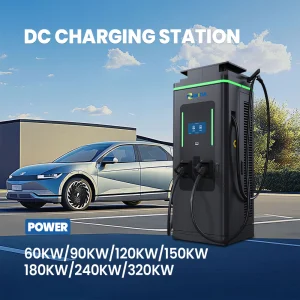
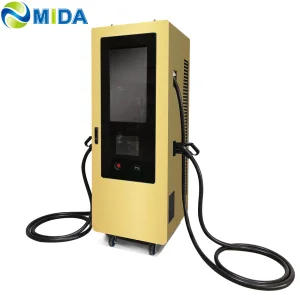
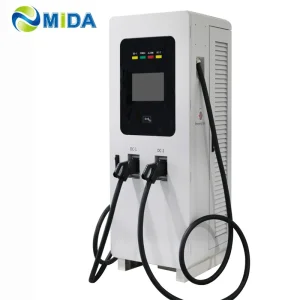
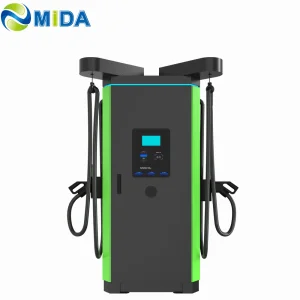
  • 60kW to 480kW Stand-alone Dual-Gun Piles
  • 60kW to 240kW Smart Advertising Chargers
  • 600kW to 1080kW Liquid-Cooled Superchargers
View More Stations

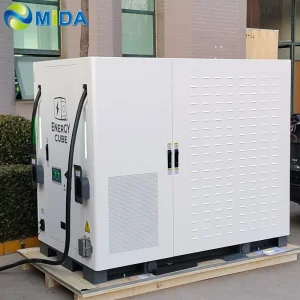
Energy Storage Charging Station

  • 15kW to 480kW Mobile BESS Charging Stations
  • 60kW to 400kW Integrated Battery-Backed Piles
  • 65kWh to 200kWh Fleet Emergency Rescue Station
  • 165kWh Automated Intelligent Charging Robot
  • 800kWh to 2000kWh Solar-Coupled Off-grid Systems
View BESS Solutions

Core Product Portfolios

Wall-Mounted / Mobile

7kW to 80kW

DC Charger Station

60kW to 1440kW

BESS Storage

60kWh to 2MWh

Global Commercial & Industrial Case Studies for 50kW DC Infrastructure

Localized Application Scenarios

Different application profiles demand specific configurations of a 50kW charging unit to maximize utility and ROI:

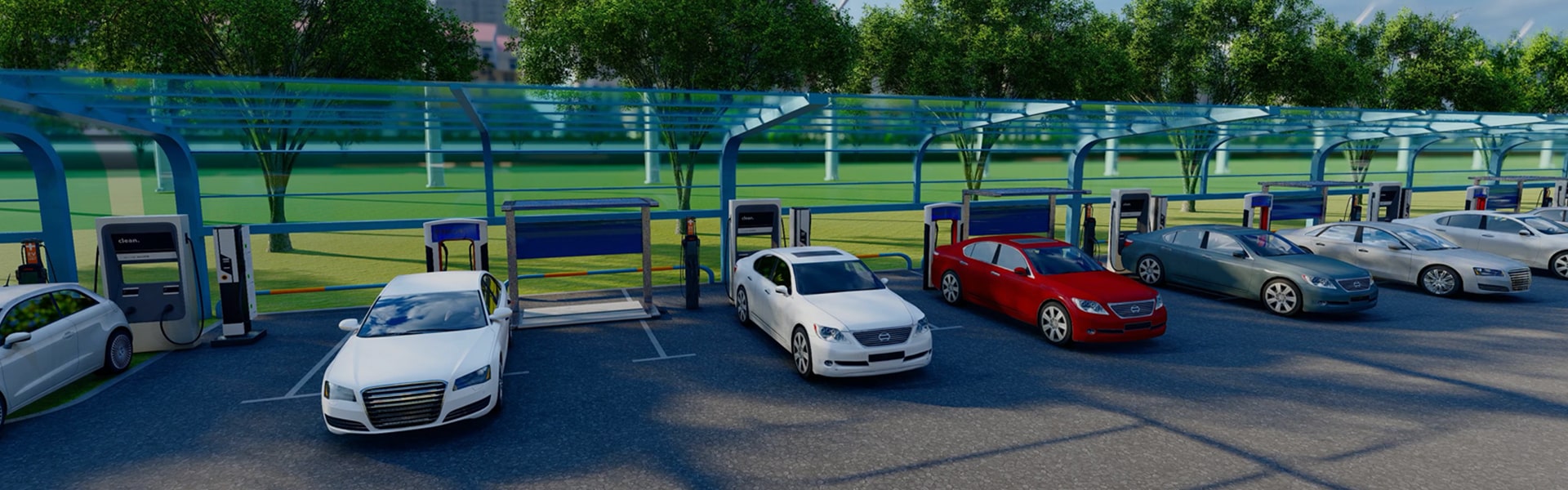
  • Commercial Fleet Depots: Delivery vans and light logistics trucks are stationary during the night or during scheduled shift changeovers. Deploying 50kW DC chargers is highly cost-effective here. Over a 4-hour window, a single 50kW plug can replenish 200kWh of battery storage, sufficient to cover full delivery routes without placing high peak-load demands on local distribution lines.
  • Urban Retail & Shopping Centers: Retail clients typically remain in parking lots for 45 to 90 minutes. Implementing a 50kW charging station provides customers with a valuable charge boost (adding 30-50kWh of capacity) during their visit, generating a reliable customer acquisition hook for the retailer.
  • Multi-Family Residential Units (MUDs): While overnight Level 2 AC charging is common, retrofitting older residential structures with high-voltage lines is often difficult. Installing a centralized 50kW DC station in a shared parking space offers quick charging access for residents who lack dedicated private parking boxes.

Frequently Asked Questions

Technical and procurement answers designed for engineering leads and utility project managers.

Q1: Can a 50kW DC fast charger run on a standard three-phase AC connection?
Yes. Typically, a 50kW DC charger requires an AC input of 380V to 415V, three-phase (50/60Hz), with a nominal input current of approximately 80A to 90A. This avoids the need for specialized medium-voltage transformers, making installation quick and cost-efficient.
Q2: How does the modular power design of MIDA 50kW chargers protect station uptime?
MIDA 50kW DC chargers utilize multiple independent hot-swappable power modules (for example, two 25kW or three 20kW modules). If one module suffers an internal fault, the charger automatically isolates that module and continues to deliver power through the remaining modules, ensuring service continuity.
Q3: Does the station support OCPP 1.6J and OCPP 2.0.1 for payment and billing integrations?
Yes, all modern MIDA chargers support native OCPP 1.6J and are upgradable to OCPP 2.0.1. This ensures full compatibility with third-party software platforms for user authentication, remote monitoring, diagnostic logs, and automated payment systems.
Q4: What certifications do MIDA 50kW chargers carry for international export?
Our products are engineered to pass major international standards, including CE (LVD/EMC), RoHS, CB scheme, and are compliant with IEC 61851-1/23/24 and ISO 15118 protocols for intelligent vehicle-to-grid communications.
Q5: How is thermal management handled inside the 50kW charger chassis?
MIDA's standard 50kW chargers feature forced-air cooling with variable-speed fans, optimized internal air ducts, and optional IP54/IP55 sealing to block external moisture and particulate dust. For ultra-quiet or dust-heavy industrial environments, liquid-cooled cooling units are also available.
Q6: What is the average lead time for wholesale custom orders from your factory?
Standard configurations have a lead time of 15 to 25 days. Custom OEM orders, which may include custom branding, specific cabinet sizing, dynamic load sharing features, or multi-gun output setups, typically take 30 to 45 days.
Q7: Can MIDA integrate solar MPPT and BESS batteries directly with the charger?
Yes. MIDA specializes in integrated microgrid architectures. We provide DC-to-DC converters and solar MPPT charger modules that connect directly to local BESS (Battery Energy Storage Systems) and solar arrays, bypassing multiple AC-to-DC conversions to optimize energy efficiency.

CORPORATE NEWS & INSIGHTS

Stay updated with the latest technological developments in global transit and heavy vehicle charging systems.
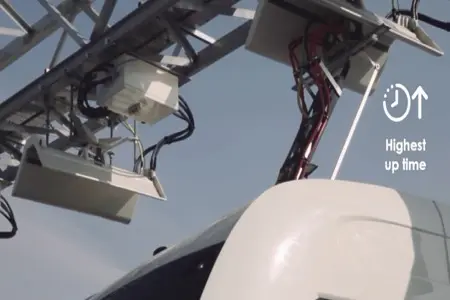
E-bus Pantograph Dome

TECHNOLOGY UPDATE

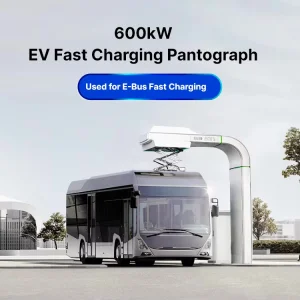
What are the advantages of an e-bus pantograph dome?

In contrast to classic plug-in charging systems, e-bus pantograph connections offer high-power automated contact, facilitating fast opportunity charging at bus depots...
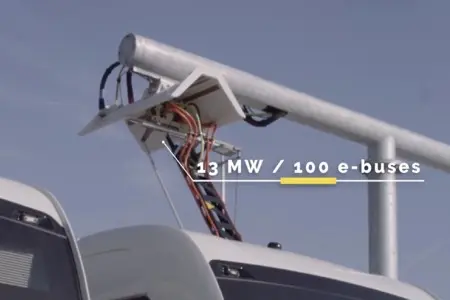
Read More
E-bus Charging Time

CHARGING ANALYSIS

How long does it take to charge with an e-bus pantograph?

Charging times depend on battery capacity and thermal limits. Pantographs can deliver massive currents, reducing bus stopover charging intervals to minutes...

Read More
Pantograph Installation

INSTALLATION MANUAL

How to Install the Pantograph Up Charger System Dome

Installing a "Pantograph Up" system dome requires precise mechanical engineering alignment, robust electrical safety breakers, and automatic software handshakes...

Read More
Mida Group Advanced Production Facility Banner