
What Are the Top Dual EV Charging Station Suppliers?

Time:2026-10-10 Author:Ethan
0%

Choosing the right Dual Ev Charging Station supplier requires more than comparing advertised charging speeds. A dependable supplier must balance hardware quality, software control, installation support, warranty coverage, and long-term service. These details become visible at busy sites, where two vehicles may arrive together and share limited electrical capacity.

Charlie Jardine, founder of EO Charging, has said, “We need to make charging as easy as filling up with petrol.” That principle remains practical. A dual-port station should offer clear instructions, stable payment access, reliable authentication, and cables that remain manageable in rain or cold weather. It should also communicate accurately with energy-management systems, especially when a building cannot support full power for both vehicles.

This guide examines leading suppliers, including ABB, ChargePoint, Wallbox, Autel Energy, Delta, and other established manufacturers. Each company approaches dual charging differently. Some emphasize commercial fleet management. Others focus on residential simplicity, compact design, or advanced load balancing. The strongest choice depends on location, vehicle turnover, grid capacity, and maintenance expectations.

A simple ranking would be convenient, but it could also be misleading. A fast station is not automatically the best station. A lower purchase price may hide software fees or difficult servicing. Readers should verify certification, connector compatibility, local support, uptime evidence, and total ownership costs before committing. Supplier claims deserve careful testing. Real-world performance can vary between a showroom demonstration and a winter parking lot.
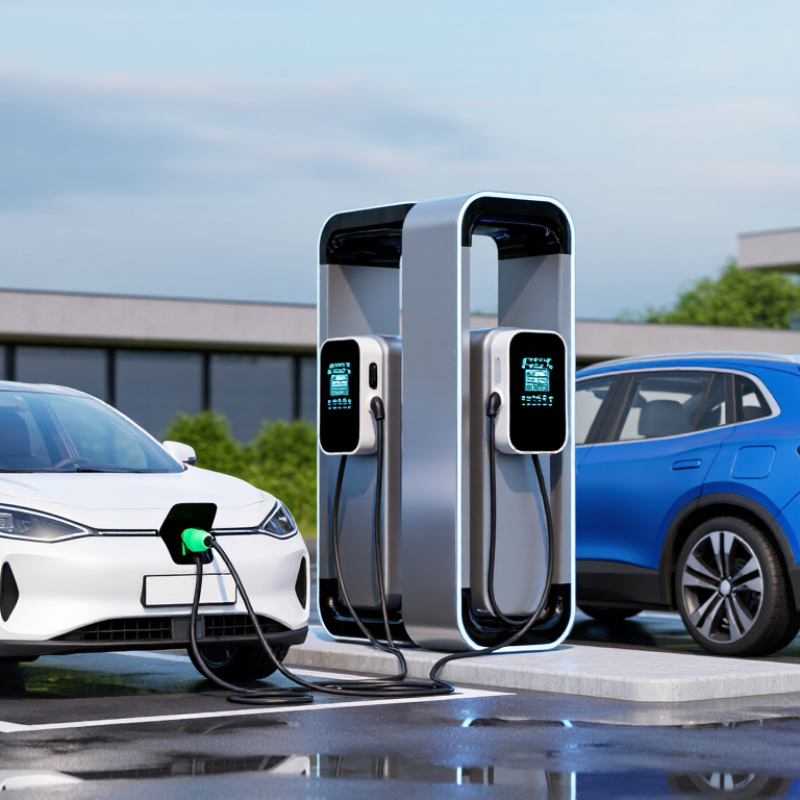
What Are the Top Dual EV Charging Station Suppliers?

What Is a Dual EV Charging Station?

What Is a Dual EV Charging Station?

A dual EV charging station serves two vehicles from one physical unit. It usually has two connectors, separate cables, and intelligent power management. Some models charge both cars simultaneously. Others alternate power between them. The difference matters. A 22-kilowatt AC station may deliver 11 kilowatts to each vehicle when both ports operate. A high-power DC unit may also reduce output during shared use. Buyers should check the datasheet, not rely on the word “dual.”

The International Energy Agency reported more than four million public charging points worldwide at the end of 2023. Over 1.3 million public chargers were added that year. This expansion increases demand for space-efficient equipment in apartments, workplaces, parking areas, and fleet depots. Dual units can reduce installation footprints and trenching costs. However, they may require stronger electrical connections, balanced circuits, and careful cable placement. Small parking sites need practical details, such as connector reach and screen visibility.

A reliable supplier should publish tested output curves, ingress protection ratings, warranty terms, and remote-monitoring capabilities. The Open Charge Alliance’s protocols support communication between charging stations and management systems. That improves fault reporting and energy control. Yet compatibility is not always perfect. Some operators discover problems after installation. Site load studies, local inspection requirements, and maintenance response times deserve equal attention. The best dual station is not automatically the fastest one. It is the unit that shares power predictably, protects users, and remains serviceable after years of daily use.

What Is a Dual EV Charging Station?

A dual EV charging station has two charging connectors, allowing two vehicles to charge at the same time. Actual charging speed depends on the station design, vehicle limits, electrical supply, and whether available power is shared between the two connectors.

Typical maximum power per connector: Level 1 up to 1.4 kW, Level 2 up to 19.2 kW, and DC fast charging commonly ranges from 50 to 350 kW.

How to Evaluate Dual EV Charging Station Suppliers

What Are the Top Dual EV Charging Station Suppliers?

How to Evaluate Dual EV Charging Station Suppliers

Evaluating dual EV charging station suppliers requires more than comparing advertised charging speeds. Examine their field experience, technical documentation, and completed projects with similar traffic patterns. Ask for references from workplaces, apartment complexes, or public parking sites. A supplier with practical installation knowledge can identify cable routing, ventilation, drainage, and electrical capacity problems early.

Check whether each charger supports recognized safety certifications, suitable ingress protection, and reliable load management. Dual ports may share power, so confirm how charging output changes when two vehicles connect simultaneously. Review protocol compatibility, remote monitoring, user authentication, and software update procedures. Test the platform during a pilot, not only through a polished demonstration. Small details matter.

Study the warranty in writing. It should explain coverage for connectors, screens, communication modules, and replacement labor. Also measure service response times, spare-parts availability, and technician coverage in your region. Ask how faults are reported at 2 a.m. That answer can reveal more than a sales presentation.

Calculate total ownership cost over several years. Include installation, network fees, energy management, maintenance, payment processing, and possible electrical upgrades. A low purchase price may become expensive after repeated service visits. I have found that supplier comparisons often miss parking behavior and winter performance. That is a weakness worth admitting. A short on-site trial can expose queueing, cable reach, and balancing issues before a large purchase.

What Are the Top Dual EV Charging Station Suppliers? - How to Evaluate Dual EV Charging Station Suppliers

Supplier evaluation framework based on measurable product, compliance, service, and commercial criteria for dual-port EV charging deployments.

Evaluation Dimension Practical Benchmark for a Dual-Port Station Information and Evidence to Request Suggested Weight Common Evaluation Risk
Dual-Port Output Configuration Two independent AC charging connectors, typically up to 7.4 kW per port on single-phase systems or up to 11–22 kW per port on three-phase systems, subject to site capacity. Technical datasheet showing rated output per connector, total cabinet capacity, connector operating modes, and simultaneous charging behavior. 15% Medium
Some products advertise the combined rating without clearly stating the output available to each vehicle.
Electrical Safety Protection should normally include overcurrent, overvoltage, undervoltage, residual-current detection, over-temperature protection, surge protection, and emergency shutdown provisions. Safety test reports, protection-circuit description, residual-current detection specification, wiring diagrams, and installation requirements. 15% High
Protection functions may vary by model, region, or optional configuration.
Regulatory Compliance Relevant conformity should cover the destination market and applicable EV charging requirements, including electrical safety, electromagnetic compatibility, and charging communication standards. Current declarations of conformity, laboratory test reports, certification scope, and documentation identifying the exact model covered. 15% High
A general corporate certificate may not apply to the specific dual-port model being quoted.
Charging Connector Compatibility Connector selection should match the target market and vehicle mix. Common AC configurations include Type 2 or Type 1, with cable length and socket options defined in advance. Connector type, cable rating, ingress protection details, mechanical life specification, and regional compatibility statement. 8% Medium
Connector availability and cable options can differ between regional product variants.
Load Management Dynamic load balancing should allocate available power between two vehicles and reduce output when the building or site reaches its configured electrical limit. Load-management logic, response time, current-transformer requirements, maximum site limit, and test results with two vehicles charging simultaneously. 12% High
Without verified load control, two ports may exceed the available service capacity or require costly electrical upgrades.
Communication and Network Support For managed deployments, support for an established open charging protocol, local commissioning, remote monitoring, firmware updates, and cellular or Ethernet connectivity is preferred. Supported protocol version, API documentation, network architecture, cybersecurity controls, update policy, and integration test procedure. 10% Medium
Compatibility may be limited when protocol functions are proprietary or only partially implemented.
Weather and Mechanical Protection Outdoor installations commonly require an enclosure rated at least IP54, with impact protection, corrosion resistance, UV-resistant materials, and operating temperatures suitable for the site. Ingress and impact test results, operating-temperature range, salt-spray or corrosion test information, and mounting instructions. 8% Medium
Advertised enclosure ratings may apply only when the unit is installed exactly as specified.
Reliability and Serviceability A credible supplier should provide component life expectations, preventive-maintenance guidance, fault-code documentation, replaceable parts, and a defined repair process. Field reliability data, warranty-return statistics, spare-parts list, repair manual, remote diagnostics capability, and service-level commitments. 10% High
Short product demonstrations do not prove long-term performance in high-use or harsh environments.
Warranty and Technical Support Commercial offers commonly specify a limited warranty of approximately 2–5 years, with separate terms for hardware, cables, payment hardware, and software services. Written warranty terms, exclusions, response times, local service coverage, escalation contacts, and replacement or repair procedures. 7% Medium
Travel, labor, shipping, and software fees may be excluded from the headline warranty period.
Total Cost of Ownership Compare equipment, installation, electrical upgrades, networking, software, maintenance, spare parts, energy management, and end-of-life costs over the planned operating period. Itemized quotation, recurring-fee schedule, installation assumptions, energy-management costs, maintenance rates, and five-year cost model. 10% High
The lowest purchase price may result in higher installation, subscription, downtime, or maintenance costs.

Key Features of Leading Dual Charging Station Suppliers

Leading dual EV charging station suppliers are judged by more than charging speed. Their equipment should support two vehicles without creating unstable power demand. Load balancing is essential when both cars charge during peak hours. It automatically shares available electricity between charging ports.

A reliable supplier provides clear output ratings, durable cables, and weather-resistant enclosures. Look for stations with adjustable current settings and protection against overheating, leakage, and voltage changes. Strong suppliers also offer software that tracks energy use, charging sessions, and maintenance alerts.

These records help property managers identify unusual consumption or repeated faults. Small details matter. A readable screen and a simple cable holder can improve daily use.

Installation support is another important feature. Experienced suppliers should provide wiring guidance, site assessments, and practical commissioning assistance. Their documentation must explain network access, firmware updates, and emergency procedures in plain language. Independent safety testing and compliance records add credibility, but certificates alone are not enough. Real operating data matters more. Ask about performance in apartment garages, workplaces, and public parking areas.

No supplier gets everything right. Some systems have excellent software but limited service coverage. Others offer robust hardware with confusing setup steps. Evaluating response times, replacement policies, and installer training can reveal these weaknesses before purchase. The best choice depends on traffic patterns, electrical capacity, user behavior, and long-term maintenance expectations.

Comparing Supplier Technology, Pricing, and Support

Choosing a dual EV charging station supplier requires more than comparing the lowest quotation. A reliable unit should support two vehicles without unstable power sharing. Dynamic load balancing helps prevent circuit overload during peak demand. Look for open communication protocols, remote diagnostics, and clear software access. These features reduce manual checks and support future fleet expansion. Weather-resistant enclosures also matter, especially in outdoor car parks.

Pricing needs careful inspection. A low equipment price may exclude cables, mounting hardware, electrical upgrades, commissioning, or network fees. Request an itemized quotation. Compare charging output, warranty length, payment terms, and expected maintenance costs. A supplier offering 22 kW total power may perform differently from one offering 22 kW per port. The specification sheet should state this clearly. Some quotes still leave too much room for interpretation.

Support quality becomes visible after installation. Ask how quickly technical teams respond, whether spare parts are stocked locally, and who handles firmware problems. A practical supplier can provide wiring guidance, installation training, and usage reports. Test the support process before signing. Send a detailed question and measure the response. A polished sales presentation is not proof of dependable service. I would also check real project references, although references can be selective. No evaluation is perfect. A careful comparison should include site conditions, user behavior, and the cost of downtime.

How to Choose the Right Dual EV Charging Station Supplier

What Are the Top Dual EV Charging Station Suppliers?

How to Choose the Right Dual EV Charging Station Supplier

Choosing a dual EV charging station supplier starts with site reality, not brochure power ratings. The International Energy Agency’s Global EV Outlook 2024 counted over four million public charging points worldwide at the end of 2023. It also recorded 1.3 million additions that year. This growth increases pressure on reliable hardware and responsive support. Ask suppliers for independent safety testing, warranty terms, software update policies, and documented uptime. Evidence matters.

For a dual unit, confirm whether both connectors charge simultaneously. A 22 kW connection may provide 11 kW per vehicle, or less during demand control. Request load-balancing diagrams, connector standards, IP ratings, operating temperatures, and installation requirements. The U.S. National Renewable Energy Laboratory’s 2030 National Charging Network report estimates that America may need about 28 million charging ports by 2030. That scale makes energy management essential. Do not trust a generic savings calculator.

Service capability often separates a suitable supplier from an attractive one. Check spare-parts availability, technician response times, remote diagnostics, payment compatibility, and data export. Ask for references from sites with similar traffic, climate, and parking duration. Test a pilot installation for several weeks. Test it. Small failures reveal big gaps. No supplier is perfect, and I would not pretend otherwise. However, unclear escalation procedures are warning signs, while low purchase costs can create expensive downtime.

FAQS

What is a dual EV charging station?

It charges two electric vehicles from one physical unit. It usually includes two connectors and separate cables.

Can both vehicles charge at the same time?

Some stations charge both vehicles simultaneously. Others alternate power between the connectors. Check the technical datasheet carefully.

How is charging power shared between two vehicles?

A 22-kilowatt connection may provide 11 kilowatts per vehicle. Output can drop further during demand control. Power sharing varies.

Why are dual charging stations useful for parking sites?

One unit can serve two parking spaces. This may reduce equipment footprints, trenching, and installation work. Cable reach still matters.

What electrical requirements should buyers review?

Ask for load-balancing diagrams, circuit details, connector standards, and installation requirements. A site load study can prevent unpleasant surprises.

Which technical details should a supplier provide?

Request tested output curves, ingress protection ratings, operating temperatures, and warranty terms. Remote monitoring is useful for spotting faults early.

How can buyers evaluate supplier support?

Check spare-parts availability, technician response times, software updates, and data export options. Ask for references from similar sites.

Is the cheapest dual charging station the best choice?

Not always. Low purchase costs can lead to expensive downtime. A pilot test lasting several weeks may expose weaknesses, though no test predicts everything.

Conclusion

A Dual Ev Charging Station is a practical solution designed to charge two electric vehicles at the same time, helping homes, workplaces, parking facilities, and commercial sites improve charging efficiency. This guide explains how to evaluate suppliers by examining product reliability, charging speed, safety certifications, installation requirements, software functions, warranty coverage, and after-sales service. It also highlights the key features of leading suppliers, including smart energy management, load balancing, durable construction, user-friendly controls, and compatibility with different electric vehicle models.

When comparing suppliers, buyers should consider the total cost rather than focusing only on the initial purchase price. Hardware quality, operating expenses, maintenance support, connectivity options, and system scalability can all affect long-term value. The right supplier should offer dependable technology, transparent pricing, responsive technical assistance, and solutions suited to the site’s power capacity and usage needs. By comparing these factors carefully, customers can select a Dual Ev Charging Station supplier that supports safe, convenient, and efficient charging over time.

Ethan

Ethan

Ethan is a seasoned marketing professional with a deep expertise in our company's innovative product line. With a passion for sharing knowledge and insights, he takes the lead in regularly updating our corporate blog, where he explores industry trends, product features, and effective marketing......